

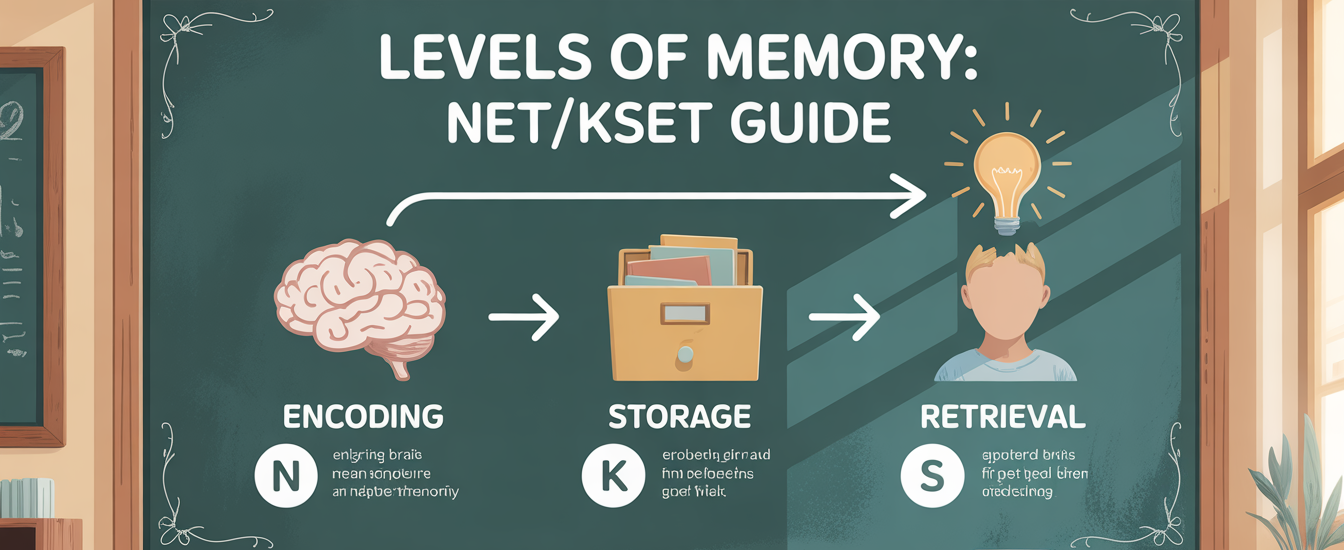
Struggling to remember the three levels of memory for your exam? You are not alone. Many aspirants find memory models confusing and hard to recall. This guide changes everything. Welcome to the most comprehensive teaching levels of memory guide with powerful mnemonics for NET and KSET success.
Why Teaching Levels of Memory Matters for Your Exam
First, memory is fundamental to teaching aptitude. It explains how learning happens. Furthermore, questions on memory levels appear frequently in Paper 1. Consequently, mastering this topic ensures easy marks. The three levels of memory form the backbone of cognitive psychology in education.
The 2026 Exam Connection
Moreover, both KSET and UGC NET emphasize understanding learner psychology. Memory models test this directly. This guide provides simple mnemonics for instant recall. Therefore, you will answer memory questions confidently. Let’s begin with the basics.
Understanding the Three Levels of Memory
Psychologists classify memory into three distinct levels. Each level has unique characteristics. Here is the complete breakdown.
Level 1: Sensory Memory – The Gateway
Sensory memory is the shortest-term element of memory. It holds impressions briefly after stimulation ends.
Key Characteristics:
- Duration: Less than one second
- Capacity: Very large but decays rapidly
- Function: Filters incoming information
- Types: Iconic (visual), Echoic (auditory), Haptic (touch)
Real-World Example: Seeing a lightning flash and immediately forgetting it. The image stays momentarily then vanishes.
Level 2: Short-Term Memory (STM) – The Workbench
Short-term memory holds small amounts of information temporarily. It is your conscious processing space.
Key Characteristics:
- Duration: 20-30 seconds without rehearsal
- Capacity: 7±2 items (Miller’s Law)
- Function: Active processing and manipulation
- Also Called: Working memory
Real-World Example: Remembering a phone number just long enough to dial it. Then it disappears.
Level 3: Long-Term Memory (LTM) – The Permanent Store
Long-term memory stores information indefinitely. It has virtually unlimited capacity.
Key Characteristics:
- Duration: Permanent (theoretically)
- Capacity: Unlimited
- Function: Permanent knowledge storage
- Types: Explicit (declarative) and Implicit (procedural)
Real-World Example: Remembering your mother’s name or how to ride a bicycle years later.
The Information Processing Model
These three levels work sequentially. Information flows from sensory to short-term to long-term. However, attention and rehearsal determine what transfers.
The Flow:
- Input: Environment provides stimuli
- Sensory Register: Filters relevant information
- Attention: Focuses on selected input
- Short-Term Memory: Processes and rehearses
- Encoding: Transfers to permanent storage
- Long-Term Memory: Retains for future use
Powerful Mnemonics to Master Teaching Levels of Memory
Now, here are the simple mnemonics that guarantee recall. Use these during exam stress.
Mnemonic 1: The “S-S-L” Sequence
Remember the order: Sensory → Short-term → Long-term
Memory Trick: “Students Should Learn” or “Study Smartly Lads”
Mnemonic 2: The Duration Formula
Remember durations using numbers: 1-30-∞
- Sensory: 1 second or less
- Short-Term: 30 seconds (approximately)
- Long-Term: Infinite (theoretically)
Mnenomic 3: The Capacity Code
Remember capacities: Big-Small-Big
- Sensory: Big capacity (all sensations)
- Short-Term: Small (7±2 items)
- Long-Term: Huge (unlimited)
Mnenomic 4: The Function Phrase
Select → Process → Store
- Sensory: Selects relevant input
- Short-Term: Processes information
- Long-Term: Stores permanently
Mnenomic 5: The Name Trick
Use names: Isha → Sohan → Lakshmi
- Iconic/Isha = Sensory
- Short-term/Sohan = STM
- Long-term/Lakshmi = LTM
Detailed Comparison Table for Quick Revision
| Feature | Sensory Memory | Short-Term Memory | Long-Term Memory |
|---|---|---|---|
| Duration | < 1 second | 20-30 seconds | Permanent |
| Capacity | Very large | 7±2 chunks | Unlimited |
| Function | Filter input | Process info | Store knowledge |
| Loss Cause | Decay | Decay/Displacement | Interference/Decay |
| Retrieval | Not possible | Immediate | Requires cues |
Types Within Each Memory Level
Understanding subtypes adds depth to your answers.
Sensory Memory Subtypes
- Iconic Memory: Visual information (lasts 250-500 milliseconds)
- Echoic Memory: Auditory information (lasts 3-4 seconds)
- Haptic Memory: Touch information (lasts approximately 2 seconds)
Short-Term Memory Components (Baddeley’s Model)
- Central Executive: Control system
- Phonological Loop: Verbal information
- Visuospatial Sketchpad: Visual/spatial data
- Episodic Buffer: Integrates information
Long-Term Memory Divisions
Explicit (Declarative) Memory:
- Episodic: Personal experiences
- Semantic: General knowledge facts
Implicit (Non-Declarative) Memory:
- Procedural: Skills and habits
- Priming: Unconscious influences
- Conditioning: Learned associations
The Atkinson-Shiffrin Model (1968)
This classic model explains the three memory stores. It remains exam-relevant today.
Key Points:
- Information passes through all three stages linearly
- Control processes (attention, rehearsal) determine transfer
- Each store differs in duration, capacity, and coding
- Model explains basic memory functioning
Exam Tip: Mentioning theorists like Atkinson and Shiffrin adds authority to answers.
Craik & Lockhart’s Levels of Processing (1972)
This alternative view deserves mention. It focuses on processing depth rather than separate stores.
Three Processing Levels:
- Shallow: Structural processing (appearance)
- Intermediate: Phonemic processing (sound)
- Deep: Semantic processing (meaning)
Connection: Deeper processing leads to better long-term retention. This explains why understanding beats rote learning.
Educational Implications of Memory Levels
As a teacher, understanding memory improves instruction. Here are practical applications.
For Sensory Memory
- Use multisensory teaching approaches
- Gain student attention before presenting content
- Minimize distractions in classroom
- Use visual aids and auditory cues
For Short-Term Memory
- Present information in small chunks
- Allow processing time between concepts
- Use repetition and review
- Connect new information to prior knowledge
For Long-Term Memory
- Create meaningful learning experiences
- Use stories and examples
- Encourage elaboration and discussion
- Provide regular retrieval practice
Common Exam Questions on Memory Levels
Based on previous KSET question papers, here are typical questions.
Sample Question 1
Q: Which memory store has the shortest duration?
A: Sensory memory (less than 1 second)
Sample Question 2
Q: According to Miller, what is the capacity of short-term memory?
A: 7±2 chunks of information
Sample Question 3
Q: Procedural memory is a type of which memory system?
A: Long-term memory (implicit)
Sample Question 4
Q: Which component of working memory handles verbal information?
A: Phonological loop
Memory-Enhancing Techniques for Exam Preparation
Use these techniques yourself while studying memory.
Technique 1: Chunking
Break information into meaningful groups. For memory levels: S-S-L (Sensory, Short-term, Long-term)
Technique 2: Elaborative Rehearsal
Connect new information to existing knowledge. Relate memory levels to your daily experiences.
Technique 3: Visual Imagery
Create mental pictures. Imagine sensory memory as a camera flash, STM as a small whiteboard, LTM as a huge library.
Technique 4: Organization
Categorize information systematically. Our comparison table does exactly this.
Technique 5: Testing Effect
Regularly test yourself. Use flashcards for memory level characteristics.
Mnemonic Devices for Related Concepts
Expand your memory toolkit with these additional mnemonics.
For Memory Processes (Encoding-Storage-Retrieval)
Use Every Student Remembers
- Encoding: Input process
- Storage: Retention process
- Retrieval: Access process
For Forgetting Causes
Use Dirty Cats Interfere
- Decay: Memory fades over time
- Cue-dependent: Missing retrieval cues
- Interference: Other memories block access
For Improving Memory
Use Really Enjoy Healthy Eating
- Rehearsal: Practice and repeat
- Elaboration: Add meaning
- Heuristics: Use mental shortcuts
- Emotion: Connect feelings

Memory Disorders and Exceptional Cases
Understanding memory problems enriches your answers.
Amnesia Types
- Anterograde: Cannot form new memories
- Retrograde: Cannot recall past memories
Famous Case Studies
- HM: Lost ability to form new explicit memories
- Clive Wearing: Severe anterograde and retrograde amnesia
Memory Across the Lifespan
Memory abilities change with age. This matters for teaching diverse learners.
Childhood
- Sensory memory develops first
- Short-term memory capacity increases with age
- Long-term memory improves with language development
Adulthood
- Peak memory function in early adulthood
- Procedural memory remains strong
- Working memory may decline slightly
Elderly
- Sensory memory slows down
- Short-term memory shows decline
- Long-term semantic memory preserved well
Neuroscience of Memory
Basic brain areas involved in memory:
- Hippocampus: Forms new explicit memories
- Amygdala: Emotional memories
- Cerebellum: Procedural memories
- Prefrontal Cortex: Working memory
- Temporal Lobe: Semantic memory
Teaching Strategies Based on Memory Levels
Apply this knowledge in your teaching career.
Lesson Planning
- Introduction: Capture sensory memory with hooks
- Presentation: Chunk content for short-term memory
- Practice: Enable encoding to long-term memory
- Review: Strengthen retrieval pathways
Classroom Techniques
- Use advance organizers
- Provide structured notes
- Incorporate frequent reviews
- Use mnemonic instruction
- Connect to student experiences
Memory and Technology
Modern teaching incorporates digital tools for memory enhancement.
- Educational Apps: Spaced repetition software
- Multimedia: Engages multiple sensory channels
- Gamification: Makes learning memorable
- Digital Flashcards: Portable practice tools
Common Misconceptions About Memory
Clear these for exam success.
- Myth: We use only 10% of our brain
- Fact: We use all brain areas, just not simultaneously
- Myth: Memory works like video recording
- Fact: Memory is reconstructive, not reproductive
- Myth: Older adults cannot learn new things
- Fact: Neuroplasticity continues throughout life
Practice Questions for Self-Assessment
Test your understanding with these questions.
Question 1
Match the following:
- Sensory Memory A. 7±2 chunks
- Short-Term Memory B. Unlimited capacity
- Long-Term Memory C. Less than 1 second
Answer: 1-C, 2-A, 3-B
Question 2
Which type of long-term memory involves personal experiences?
A) Semantic
B) Episodic
C) Procedural
D) Priming
Answer: B) Episodic
Question 3
The phonological loop is a component of:
A) Sensory memory
B) Short-term memory
C) Long-term memory
D) Episodic memory
Answer: B) Short-term memory
Quick Revision Points for Exam Day
Memorize these key facts.
- Three Levels: Sensory, Short-term, Long-term
- Sensory Duration: < 1 second
- STM Duration: 20-30 seconds
- STM Capacity: 7±2 items
- LTM Duration: Permanent
- LTM Capacity: Unlimited
- Key Theorists: Atkinson & Shiffrin (1968)
- Working Memory Model: Baddeley & Hitch
Connecting Memory to Other Teaching Aptitude Topics
Memory links to several other syllabus areas.
With Teaching Methods
- Repetition works through memory consolidation
- Active learning strengthens long-term memory
With Learning Theories
- Behaviorism focuses on conditioning (implicit memory)
- Cognitivism emphasizes information processing
With Individual Differences
- Memory capacity varies among learners
- Learning styles affect memory encoding
Conclusion: Your Memory Mastery Complete
You now understand teaching levels of memory completely. The three levels of memory are clear. Our simple mnemonics ensure instant recall. From sensory through short-term to long-term, you have mastered it all. Apply this knowledge for exam success and effective teaching.
Ready for more comprehensive preparation? Get Luminous Leaf Publication’s complete Teaching Aptitude guide with all memory topics explained bilingually. Join our Telegram community for daily memory-based practice questions, expert discussions, and study tips. Your NET/KSET success journey continues!
Frequently Asked Questions (FAQs)
What are the three levels of memory according to Atkinson-Shiffrin model?
The three levels are sensory memory, short-term memory, and long-term memory. Sensory memory holds information briefly, short-term memory processes actively, and long-term memory stores permanently. This model is fundamental to understanding teaching levels of memory.
How can I remember the duration of each memory level for exams?
Use the mnemonic “1-30-∞”. Sensory memory lasts less than 1 second, short-term memory lasts approximately 30 seconds, and long-term memory theoretically lasts forever. This simple mnemonic ensures quick recall during exams.
What is the difference between short-term and working memory?
Short-term memory refers to temporary storage, while working memory includes both storage and active processing. Working memory is the updated concept that includes manipulation of information. Both terms appear in KSET question papers.
Which memory level has the largest capacity?
Long-term memory has virtually unlimited capacity. It can store vast amounts of information permanently. Sensory memory also has large capacity but extremely short duration. Short-term memory has the smallest capacity (7±2 chunks).
How does understanding memory levels help in teaching?
Teachers use this knowledge to design effective lessons. They capture sensory memory with engaging openings, respect short-term memory limits by chunking content, and strengthen long-term memory through meaningful practice. This is essential teaching aptitude application.
What are the types of long-term memory?
Long-term memory divides into explicit (conscious) and implicit (unconscious). Explicit includes episodic (personal events) and semantic (facts). Implicit includes procedural (skills), priming, and conditioning. These levels of memory subtypes appear frequently in exams.
Can you suggest more mnemonics for memory levels?
Yes! Try “Silly Students Learn” for Sensory-Short-Long. For characteristics, use “Big-Small-Big” (capacity pattern) and “Select-Process-Store” (functions). These simple mnemonics make revision effortless.
What causes forgetting from each memory level?
Sensory memory loses information through decay (fading). Short-term memory loses through decay or displacement (new information pushing out old). Long-term memory loses through interference (other memories blocking access) or retrieval failure.
How is the three-level memory model relevant for NET/KSET Paper 1?
Paper 1’s Teaching Aptitude unit extensively covers learner characteristics. Memory models explain how students process and retain information. Questions on teaching levels of memory test your understanding of fundamental learning processes.
Where can I find more practice questions on memory levels?
Luminous Leaf Publication’s Teaching Aptitude workbook includes 100+ memory-based questions with detailed solutions. Our Telegram group shares daily practice MCQs. The official KSET website also has previous papers with memory-related questions.