


- The Ultimate Guide to KSET Paper 1 Syllabus & Pattern: Complete 2026 Mastery Blueprint
- Why Understanding KSET Paper 1 Syllabus & Pattern Determines Your Success
- Complete Analysis: KSET Paper 1 Exam Pattern 2026
- Detailed Unit-by-Unit KSET Paper 1 Syllabus Breakdown
- Unit 1: Teaching Aptitude – The Educator's Foundation
- Unit 2: Research Aptitude – The Scientific Methodology
- Unit 3: Reading Comprehension – Critical Analysis Skills
- Unit 4: Communication – The Art of Expression
- Unit 5: Mathematical Reasoning – Logical Numeracy
- Unit 6: Logical Reasoning – Deductive Thinking
- Unit 7: Data Interpretation – Information Analysis
- Unit 8: ICT in Education – Digital Transformation
- Unit 9: People & Environment – Sustainable Development
- Unit 10: Higher Education – Governance Systems
- Advanced Preparation Strategy for KSET Paper 1 Syllabus & Pattern
- Essential Resource Guide for KSET Paper 1 Mastery
- Common Mistakes in KSET Paper 1 Preparation
- Expert Tips for Each Syllabus Unit
- Time Management Strategy for Exam Day
- Last-Month Preparation Strategy
- Conclusion: Your Complete Roadmap to KSET Paper 1 Success
- Frequently Asked Questions (FAQs)
- How many questions come from each unit in KSET Paper 1?
- Is the KSET Paper 1 pattern same every year?
- How to manage time between Paper 1 and Paper 2 preparation?
- Are coaching classes necessary for KSET Paper 1 preparation?
- What is the most effective way to revise all 10 units before exam?
The Ultimate Guide to KSET Paper 1 Syllabus & Pattern: Complete 2026 Mastery Blueprint
Starting your KSET preparation feels overwhelming. Paper 1 seems vast and confusing. You need clarity and direction immediately. This comprehensive guide solves that problem completely. Welcome to the ultimate guide to KSET Paper 1 syllabus & pattern. We provide exact strategies for 2026 success.
Why Understanding KSET Paper 1 Syllabus & Pattern Determines Your Success
First, Paper 1 is your foundation. It tests essential teaching and reasoning skills. Furthermore, it follows the official UGC NET pattern exactly. Consequently, mastering it gives you immediate advantage. Many candidates neglect this common paper syllabus. However, smart aspirants use it for high scores.
The 2026 Examination Landscape: Critical Insights
Moreover, the Karnataka State Eligibility Test updates notifications annually. The core syllabus breakdown remains stable though. This guide analyzes every element deeply. Therefore, you gain complete exam mastery. Let’s begin with the fundamental structure.
Complete Analysis: KSET Paper 1 Exam Pattern 2026
Knowing the format is crucial. Here is the detailed KSET Paper 1 pattern based on latest notifications.
- Examination Structure: Two papers (Paper 1 General, Paper 2 Subject)
- Paper 1 Questions: 50 mandatory MCQs
- Total Marks: 100 marks (2 marks per question)
- Duration: Combined 3 hours for both papers
- Marking Scheme: No negative marking
- Medium: English or Kannada (your choice)
- Qualifying Marks: General: 40%, Reserved: 35%
This format demands speed and accuracy. Therefore, your strategy must address both. Now, explore the complete syllabus.
Detailed Unit-by-Unit KSET Paper 1 Syllabus Breakdown
The common paper syllabus contains 10 units. Each unit requires specific approach. Here is your exhaustive guide.
Unit 1: Teaching Aptitude – The Educator’s Foundation
This unit covers teaching fundamentals. It represents the core teaching philosophy.
- Nature of Teaching: Concept, objectives, characteristics
- Learner’s Psychology: Characteristics, differences, learning styles
- Teaching Methods: Modern vs traditional approaches
- Evaluation Systems: Assessment types and tools
- Preparation Strategy: Create real classroom examples for each concept. Practice application-based questions daily.
Unit 2: Research Aptitude – The Scientific Methodology
Furthermore, this unit tests research understanding. It evaluates logical thinking capacity.
- Research Basics: Meaning, purpose, types
- Research Methods: Quantitative, qualitative, mixed approaches
- Research Ethics: Plagiarism, copyright, authorship
- Statistical Tools: Basic applications in research
- Preparation Strategy: Focus on differentiating research types of research. Memorize ethical guidelines thoroughly.
Unit 3: Reading Comprehension – Critical Analysis Skills
Additionally, this section tests language proficiency. You must interpret passages accurately.
- Passage Types: Narrative, descriptive, argumentative, analytical
- Question Patterns: Main idea, inference, vocabulary, tone
- Speed Reading: Techniques for faster comprehension
- Practice Sources: Editorials, academic journals, reports
- Preparation Strategy: Practice two passages daily. Time yourself strictly. Improve vocabulary systematically.
Unit 4: Communication – The Art of Expression
Consequently, effective communication is vital for educators. This unit covers complete process.
- Communication Types: Verbal, non-verbal, written, visual
- Communication Barriers: Physical, psychological, cultural
- Classroom Communication: Effective techniques and tools
- Mass Media: Role in education and society
- Preparation Strategy: Analyze daily communication examples. Understand barriers practically.
Unit 5: Mathematical Reasoning – Logical Numeracy
However, this section seems challenging. Actually, it uses basic mathematical concepts.
- Number Systems: Types, properties, operations
- Arithmetic: Percentages, ratios, averages, profit-loss
- Geometry: Basic shapes, areas, volumes
- Statistics: Mean, median, mode, interpretation
- Preparation Strategy: Learn calculation shortcuts. Practice mental mathematics daily.
Unit 6: Logical Reasoning – Deductive Thinking
This unit tests analytical abilities. It requires systematic thinking approach.
- Arguments: Structure, premises, conclusions
- Logical Patterns: Analogies, classifications, series
- Venn Diagrams: Two and three circle applications
- Fallacies: Common reasoning errors
- Preparation Strategy: Solve puzzles regularly. Identify argument patterns consciously.
Unit 7: Data Interpretation – Information Analysis
Moreover, this is highly scoring section. It involves visual information processing.
- Data Sources: Primary and secondary types
- Graphical Representation: Tables, bars, pies, lines
- Data Analysis: Trends, comparisons, projections
- Percentage Calculations: Quick computation methods
- Preparation Strategy: Practice graph interpretation daily. Master percentage calculations.
Unit 8: ICT in Education – Digital Transformation
In the digital age, ICT knowledge is mandatory. This unit covers essential concepts.
- ICT Basics: Hardware, software, networks
- Digital Initiatives: SWAYAM, MOOCs, virtual labs
- E-Learning Tools: Applications in teaching
- Cyber Security: Basic concepts and ethics
- Preparation Strategy: Follow official UGC Digital Initiatives. Explore educational apps practically.
Unit 9: People & Environment – Sustainable Development
Furthermore, this unit connects society with environment. It covers crucial interrelationships.
- Sustainable Development: Goals and indicators
- Environmental Issues: Pollution, conservation, laws
- Human Development: Indicators and measurement
- Current Policies: National and state initiatives
- Preparation Strategy: Link topics to current affairs. Follow environmental news regularly.
Unit 10: Higher Education – Governance Systems
Finally, this unit tests system knowledge. It covers educational administration completely.
- Higher Education Structure: Universities, colleges, institutions
- Professional Bodies: UGC, AICTE, NAAC, NCTE
- Educational Policies: NEP 2020, historical developments
- Quality Assurance: Accreditation, ranking systems
- Preparation Strategy: Create comparison charts of bodies. Understand NEP 2020 thoroughly.
Advanced Preparation Strategy for KSET Paper 1 Syllabus & Pattern
Knowing the syllabus breakdown is insufficient. You need strategic implementation. Follow this 8-week mastery plan.
Week 1-2: Foundation Building Phase
- Diagnostic Test: Take full mock test immediately
- Resource Collection: Gather all study materials
- Unit Prioritization: Identify strong and weak areas
- Schedule Creation: Daily and weekly study planner
Week 3-6: Intensive Learning Phase
- Daily Targets: Complete specific sub-topics daily
- Concept Mapping: Create visual notes for each unit
- Practice Questions: Solve 50 MCQs daily minimum
- Weekly Revision: Sunday dedicated to revision
Week 7: Integration Phase
- Mixed Practice: Random topic question solving
- Speed Building: Timed practice sessions
- Weakness Addressing: Focus on difficult areas
- Full-Length Tests: Two complete mock tests
Week 8: Final Preparation Phase
- Comprehensive Revision: All units rapid revision
- Formula/Concept Review: Key points memorization
- Test Strategy Finalization: Question approach planning
- Confidence Building: Positive mindset development

Essential Resource Guide for KSET Paper 1 Mastery
Selecting right resources is critical. Here is categorized resource list.
Official Sources (Mandatory)
- KSET Official Website: https://kset.uni-mysore.ac.in/
- UGC NET Portal: https://ugcnet.nta.nic.in/
- Previous Year Papers: Last 5 years essential
- Official Notifications: Regular checking required
Recommended Study Materials
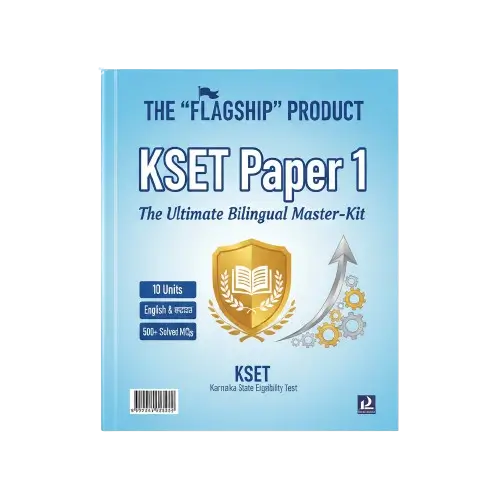
- Luminous Leaf Publication KSET Paper 1 Guide: Complete bilingual coverage
- Teaching Aptitude Specialized Book: Deep conceptual clarity
- Research Aptitude Workbook: Practical application focus
- Current Affairs Compilation: Monthly updates edition
Practice Resources
- Question Bank: 5000+ MCQs with solutions
- Mock Test Series: 20 full-length tests
- Topic-wise Tests: Individual unit assessments
- Previous Papers Compilation: 10 years solved papers
Common Mistakes in KSET Paper 1 Preparation
Avoid these frequent errors completely.
- Neglecting Certain Units: All 10 units are equally important
- Rote Memorization: Understanding application is crucial
- No Time Management: Practice with strict timing always
- Ignoring Current Affairs: Units 9 and 10 need regular updates
- Skipping Mock Tests: Actual exam simulation is essential
- Poor Revision Planning: Regular revision non-negotiable
Expert Tips for Each Syllabus Unit
Implement these specific strategies for maximum marks.
For Teaching & Research Aptitude Units
- Connect theories to practical examples
- Create comparative charts for different methods
- Practice scenario-based questions extensively
- Use our Teaching Aptitude Master Class for deep learning
For Comprehension & Communication
- Read diverse materials daily
- Practice summarizing passages
- Analyze communication in daily life
- Build vocabulary systematically
For Reasoning & Data Sections
- Learn shortcut methods
- Practice mental calculations
- Solve puzzles regularly
- Use elimination techniques
For ICT & Current Units
- Follow official websites
- Make notes on digital initiatives
- Connect to real-world examples
- Review monthly current affairs
Time Management Strategy for Exam Day
Perfect timing ensures complete attempt. Follow this allocation.
- First 30 Minutes: Teaching & Research Aptitude (20 questions)
- Next 20 Minutes: Comprehension & Communication (10 questions)
- Following 25 Minutes: Reasoning & Data (15 questions)
- Last 15 Minutes: Remaining units (5 questions)
- Final 10 Minutes: Review and corrections
Last-Month Preparation Strategy
The final month decides your performance. Implement this plan strictly.
Week Before Exam
- Complete all revision notes
- Take three full mock tests
- Analyze performance gaps
- Finalize exam strategy
Last Three Days
- Light revision only
- Formula and date review
- No new topics
- Positive visualization
Exam Day
- Reach center early
- Carry all documents
- Follow time allocation
- Stay calm and focused
Conclusion: Your Complete Roadmap to KSET Paper 1 Success
This ultimate guide to KSET Paper 1 syllabus & pattern provides everything needed. You now understand all 10 units completely. The official UGC NET pattern is clear. Your syllabus breakdown is exhaustive. Implementation brings certain success.
Begin your journey with perfect resources. Get Luminous Leaf Publication’s complete KSET Paper 1 kit with bilingual guides, question banks, and mock tests. Join our exclusive Telegram community for daily guidance, peer support, and expert mentoring. Your KSET qualification starts today!
Frequently Asked Questions (FAQs)
How many questions come from each unit in KSET Paper 1?
The distribution varies yearly. However, Teaching Aptitude and Research Aptitude typically have 10-12 questions combined. Comprehension has 5 passages with 10 questions. Remaining units share approximately 25-30 questions. Complete syllabus breakdown preparation is essential.
Is the KSET Paper 1 pattern same every year?
The core KSET Paper 1 pattern remains consistent regarding total questions, marks, and duration. However, question difficulty and unit weightage may vary slightly. Following the official UGC NET pattern ensures you’re prepared for any variation.
How to manage time between Paper 1 and Paper 2 preparation?
Allocate 40% time to Paper 1 initially. Master the common paper syllabus first as it applies to all subjects. Then shift to 60% Paper 2 focus while revising Paper 1 regularly. Balance is crucial for both papers.
Are coaching classes necessary for KSET Paper 1 preparation?
Not necessarily. With proper self-study materials like our comprehensive guides and consistent practice through mock tests, you can clear Paper 1 successfully. Many candidates achieve success through disciplined self-preparation.
What is the most effective way to revise all 10 units before exam?
Create one-page summaries for each unit. Use mind maps and flowcharts. Revise two units daily in the final month. Practice mixed question sets regularly. This integrated approach ensures complete syllabus breakdown retention.